


ANSWERS TO THE MOST COMMON COOL CUBE™ QUESTIONS
Why is there a "recommended replacement date" on the VIP insulation? Does it expire?
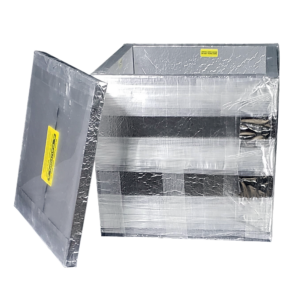
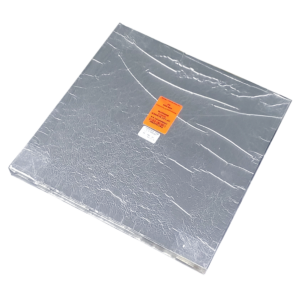
The orange “recommended replacement date” sticker on the Cool Cube™ VIP is set 5 years from the manufacture date. VIP insulation gradually loses about 1% of insulating effectiveness per year, meaning the panel still retains about 95% of its performance at that recommended replacement date. This is not a strict expiration date, but a guideline to help users determine when replacement may be appropriate based on their operational needs.
If your VIP has reached the recommended replacement date and you use your Cool Cube™ for shorter hold time durations (1 day), you may not need to replace your VIP insulation by this date. As long as your VIP insulation’s vacuum is fully intact (no punctures or looseness) and your Cool Cube™ is maintaining temperature performance as needed, you do not need to replace the VIP insulation.
If your VIP has reached the recommended replacement date and you use your Cool Cube™ for long hold time durations (2-3 days), you may begin to see a decrease in the length of time your Cool Cube™ can maintain a target temperature. Test your system and if you see a decrease in performance, it is time to replace your VIP insulation. Replace the VIP insulation and your Cool Cube™ will perform like new again. Call us at 608-526-6901 or email us at info@vericormed.com and we can help you order the right VIP insulation for your Cool Cube™ model.
Why isn't my Cool Cube™ holding the correct temperature for very long?
Assuming the PCM panels are prepared properly, the only other part of the system to check is the Temp-Shield™ VIP (Vacuum Insulated Panel) Insulation System. This system consists of six individually sealed panels that are taped together to form the six-sided assembly. The internal vacuum pressure gives each panel its extraordinary thermal performance. Inspecting each of the panels is paramount, as one compromised panel can affect the entire system. There are two ways to determine whether a panel is compromised:
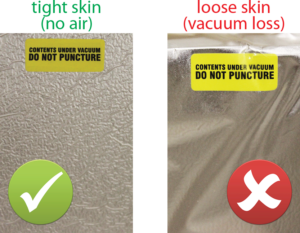
1) Visually check the skin of the panel (white in older models; silver in newer models) as it should be sucked tight to the core creating a rippled, textured surface. If it is, it still has its vacuum and is good. If the skin has a wave or two and appears loose, the panel has been compromised and will not be as effective.
2) Touching a panel can also tell a lot. Pushing on a good VIP panel, it will seem very rigid and hard. Pushing on a panel that has lost its vacuum will seem soft and squishy.
Inspect and test the entire system periodically, and even more frequently after the first 5 years. Upon testing, if the unit is performing up to requirements, it is fine to use. If it is not holding the temperatures as long as expected, it is likely a VIP panel (or panels) have lost its high R-value due to a vacuum loss. Replace the VIP insulation and your Cool Cube™ will perform like new again.
Why aren't my PCM panels getting solid?
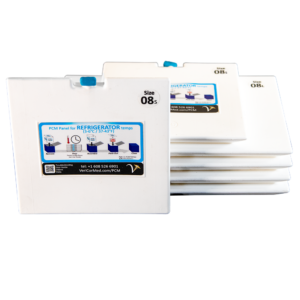
It usually is as simple as this: the PCM (Phase Change Material) panels are not cold enough for a long enough time.
- Refrigerator Temps PCM melts at 4.5 °C / 40.1 °F. At a minimum, panels need to be 3 °C / 37.4 °F or lower for a day or two to turn solid (at -15 °C / 5 °F the PCM solidifies in a couple of hours). Watch or read about various prep methods here.
- Lab Freezer Temps PCM melts at -21.5 °C / -6.7 °F. At a minimum, panels need to be -30 °C / -22 °F or lower for a day or two to turn completely solid (at -40 °C / -40 °F the PCM solidifies in a couple of hours). The Freezer Temp panels will not solidify in a standard freezer. They require an ultra-low lab freezer that reaches at least -30 °C / -22 °F or lower to completely solidify. Watch or read about various prep methods here.
- Room Temps PCM solidifies at 21.5 °C / 70.7 °F. At a minimum, panels need to be 20 °C / 68 °F or lower for a day or two to turn solid (at 5 °C / 41 °F the PCM solidifies in a couple of hours). Watch or read about various prep methods here.
PCM follows the laws of physics. If the PCM gets cold enough, it turns solid; if it gets warm enough, it turns liquid.
Candle Wax Analogy
For argument’s sake, let’s say a candle melts at 90 °F (wax melting points range from 75 °F – 180 °F). In a typical room, the candle remains solid and fluctuates its temperature with the room. However, if the room warms up to 93 °F, the candle slowly melts as it maintains its temperature at 90 °F. Once liquid, the liquid will warm up to 93 °F. Then if the room cools down to 88 °F, the wax will slowly turn solid. To turn wax from a solid to a liquid quickly, put it next to a flame or other heat source. To turn wax from a liquid to a solid quickly, put it in a cool place. Candle wax is a PCM with a melting point of 90 °F (in this circumstance). Cool Cube™ PCM panels have their own melting points. Get the panels below that temperature and the PCM solidifies. Get the panels above that temperature and the PCM liquifies.
Why is my Cool Cube™ too cold?
Most likely the PCM panels went into the Cool Cube™ a bit prematurely. When prepping the PCM panels in a cold environment, the panels can sometimes reach a temperature far below their solidifying point, as they naturally will match the temperature they are prepared in. This would make them too cold to use right away. Panels should be used right at their melting/solidifying point.
If you are using “Refrigerator PCM” panels that have been in a freezer, they are at that freezer’s temperature. You MUST let them sit out (about 20 minutes) to warm to 4.5 °C / 40.1 °F. A common reference point: if there is frost forming on the outside of the panel, they are still too cold. When you start seeing liquid condensate form on the outside, they are above 0 °C / 32 °F, and they are close to being ready to use.
VIP INSULATION
REPLACEMENT DATE
VIP INTEGRITY
PCM PANELS
For the Cool Cube™ User Guide and PCM panel prep information,
visit our Cool Cube™ support page.
MY QUESTION ISN’T HERE
Our Q&A page has a multitude of answers with a convenient search function.
You may also contact us directly with your question using one of the following methods:
1. Call 608-526-6901 (M-F) to speak with a customer specialist.
2. Email info@vericormed.com with your question.
3. Submit the form below with your question.

